Blog · · 4 min read
What Sandpaper Grit Numbers Mean and Which to Use
Updated
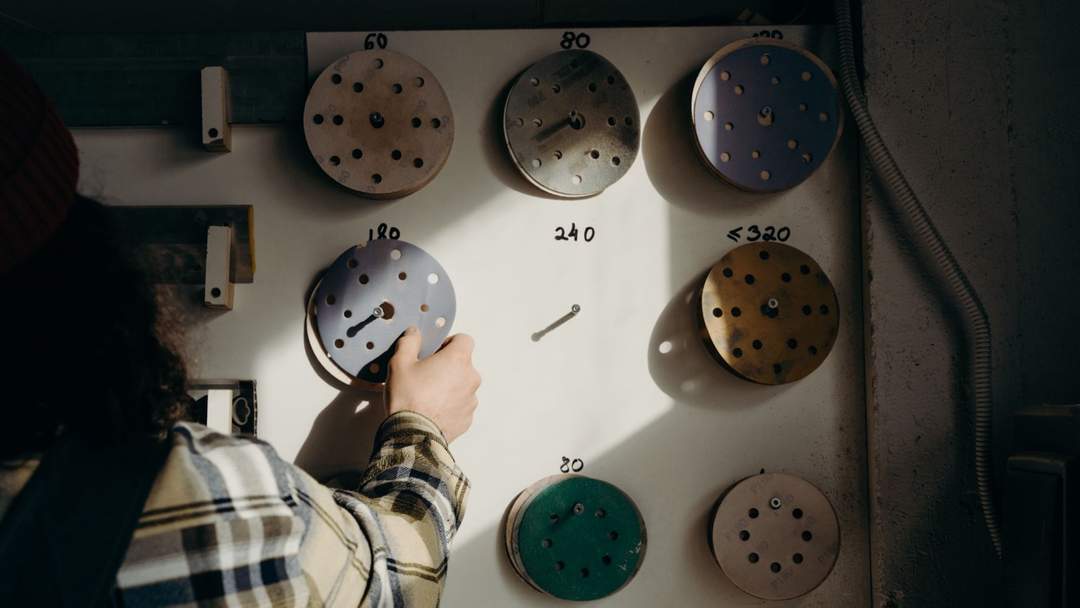
Sandpaper is a sheet, disc or sponge coated with abrasive grains, used to rub a surface down: to strip old coatings, level filler and prepare the surface for the next coat. The number on the back, P120 for example, is the grit size. The higher the number, the finer the grain and the smoother the scratch it leaves.
What the P and the number mean
The P marks the European FEPA standard used by European makers such as SMIRDEX. The number originally came from the sieve the grains passed through: the finer the mesh, the smaller the grain. Today it stands for sizes fixed in the standard. A P80 grain averages about 0.2 mm, a P400 grain about 35 microns, and a P2000 grain just over 10 microns, several times thinner than a human hair.
American sandpaper carries no P, and at fine grits the numbers stop matching: an American 600 is roughly a European P1200. When you compare two brands, always look for the P.
Which grit for which job
P24 to P60, coarse. Rust, thick layers of old paint, grinding metal on an angle grinder, first levelling of rough wood. These grits remove material fast and leave deep scratches.
P80 to P120. Shaping filler, first sanding of wood, preparing metal for primer.
P150 to P240. Feathering filler edges, sanding wood before lacquer or paint, between coats of wood lacquer.
P320 to P600. Sanding filler primer before paint, between coats of furniture lacquer.
P800 to P1500. Wet sanding before base coat, preparing a small area for a blend.
P2000 to P3000 and finer. Removing clear coat defects before polishing: dust nibs, runs, orange peel.
Do not skip grits
Each grit removes the scratches of the one before. Jump straight from P80 to P320 and the fine paper cannot reach the deep scratches, so they stay. Primer and paint hide them at first, but the coat shrinks as it dries and the scratch reappears as a line. A simple rule: each grit number should be about one and a half times the last, for example P80, P120, P180, P240.
To see where hollows or scratches remain, dust a guide coat powder over the surface before sanding. Wherever powder is still visible after sanding, the surface is not level yet.
What the grain is made of
Aluminium oxide is the all-rounder for wood, metal and paint, as in SMIRDEX 510 and 820.
Silicon carbide is sharper and more brittle and is used on waterproof sheets for wet sanding paint and clear coat, as in SMIRDEX 270.
Zirconia handles heavy metal grinding and sharpens itself as it works, which is why it is used on flap and fibre discs.
Ceramic is the most aggressive and longest-lasting grain, for hard coatings and high-volume work, as in SMIRDEX 740 and 750.
Sheet, disc, mesh or sponge
Sheets are for hand sanding and sanding blocks. An electric orbital sander takes hook-and-loop discs that stick to its pad. The holes in the disc must line up with the holes in the pad, for example 8 holes on a 125 mm disc and 6+1 or 15 on a 150 mm disc. That way dust goes into the extractor, the disc clogs more slowly and lasts longer.
A mesh disc lets dust through its whole surface: no hole alignment is needed and sanding is almost dust-free. A sanding sponge follows curves and profiles without cutting through edges. Cloth rolls and belts are for metal and belt sanders.
Dry or wet sanding
Dry sanding is fast and done by machine; with extraction or mesh discs it is the standard method in body shops today. Wet sanding is used with fine grits, from P800 up, on paint and clear coat: the water keeps the paper from clogging, flushes away the debris and leaves a flatter surface. Only waterproof paper will do.
One rule people often forget: polyester filler is never wet sanded. It absorbs water, and the moisture later rises as blisters under the paint. Filler is always sanded dry.
Safety
Sanding dust is harmful to the lungs, especially from old paint and metal. Work with a respirator, at least FFP2, and goggles, and use extraction indoors. Sandpaper, discs and accessories are on the sandpaper, discs and accessories pages. Sanding filler is covered in the filler article.
Frequently asked questions
What does P120 on sandpaper mean?
The P marks the European standard and 120 is the grit size. The higher the number, the finer the paper: P120 is a medium grit for first sanding of wood and levelling filler.
Which sandpaper should I use on wood before lacquer?
Bare wood is sanded first with P100 to P120, then P150 to P180. Between coats of lacquer, P240 to P320 is enough to give the next coat something to grip.
What is the difference between dry and wet sandpaper?
Wet sandpaper has a waterproof backing and is used at fine grits for wet sanding paint and clear coat. Dry sandpaper is for machine sanding, especially filler, which must never be sanded wet.
Why do scratches show through the paint?
A grit was skipped and the finer paper did not remove the earlier scratches. Paint shrinks as it dries and the scratch reappears as a line. Each grit number should be about one and a half times the last.